What a measurement gives you
Safety
Only a specialist measurement with certified equipment can tell whether a floor is safe.
Litigation
Measurements carried out to the standard help avoid legal disputes.
Regulations and guidelines
Slip resistance testing of floors is provided for in the guidelines of the Building Research Institute (ITB) and the guidebook of the Ministry of Investment and Development.
Hazards
A measurement result lets you act before a dangerous situation occurs.
Claims
A measurement report documents the floor's anti-slip performance and makes unfounded claims harder to bring.
Health, safety and inspections
Measurement results help meet inspectors' requirements.
What is the PTV?
Alongside the R9-R13 (DIN) ramp scale, the pendulum test and its PTV (Pendulum Test Value) result are used more and more, because they can be carried out on an installed floor, dry and wet.
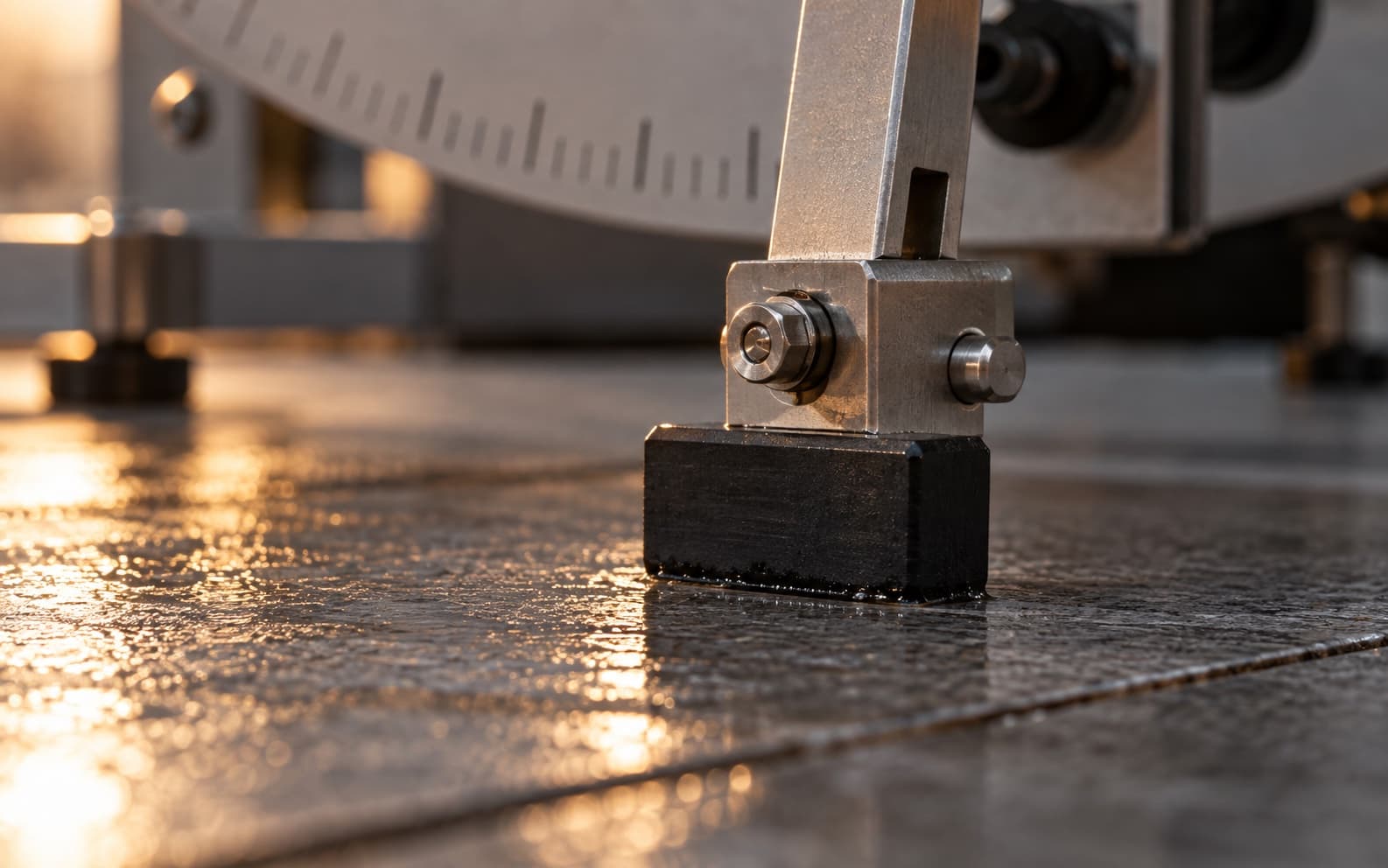
Slip risk is determined with the pendulum test, described in the Polish standard PN-EN 13036-4. The pendulum imitates a pedestrian's foot striking the tested surface, and the friction between the heel and the floor is quantified as the PTV.
The test is recommended by the Building Research Institute and the National Labour Inspectorate: for floor inspections, as part of periodic building inspections and in investigations after an accident.
The Ministry of Investment and Development considers 36 PTV the minimum value for all public buildings used by people with disabilities.
A result of 19 PTV means a very high risk of slipping (1 in 2); 36 PTV means a much lower risk (1 in a million).
Slip potential classification by the UK Health and Safety Executive (HSE).
| PTV value | Slip risk |
|---|---|
| 0-24 | High risk |
| 25-35 | Moderate risk |
| ≥ 36 | Low risk |
The British pendulum test
One way to verify a floor's slip resistance is a slip resistance test. We carry it out with the British pendulum (also called the English pendulum), hence the abbreviation PTV, for Pendulum Test Value. The test method is described in detail in PN-EN 13036-4:2011.
The British pendulum test is also recommended by the National Labour Inspectorate:
This test replicates the actual dynamics very well and imitates the movement of the heel while walking. It measures the coefficient of friction in real conditions, on both dry and wet surfaces. Various interchangeable sliders make it possible to replicate walking in shoes as well as barefoot.
The test can assess slip risk in real conditions and help establish the circumstances and causes of accidents. It answers the key question: how slippery is the floor when someone walks on it?
Measurement methods and our serviceIn which buildings should slip resistance be tested?
Keeping a floor's anti-slip properties at the right level significantly improves its safety in use. That is why testing its anti-slip parameters matters.
Two basic references indicate where testing is mandatory. The first is the Building Research Institute's guidelines: in public buildings, slip resistance should be tested once every 5 years. These include:
- Office buildings
- Healthcare buildings (e.g. hospitals, clinics)
- Retail buildings (e.g. shopping centres, supermarkets)
- Service buildings (e.g. railway stations, airports, banks)
- Educational buildings (e.g. schools, universities)
- Cultural buildings (e.g. cinemas)
- Hotels
Requirements by floor zone
The Building Research Institute has also set detailed guidelines for public buildings. The required slip resistance depends on where the floor is.
| Slip resistance (PTV) | Floor location |
|---|---|
| ≥ 36 |
|
| ≥ 36 |
|
| 80-110 |
|
Buildings accessible to people with disabilities
The second reference is the guidebook of the Ministry of Investment and Development (now the Ministry of Development and Technology), “Standards for the Design of Buildings for People with Disabilities” (2018).
It states that surfaces should be slip-resistant and keep their parameters in severe weather too: in a test to PN-EN 13036-4 or PN-EN 14231, the slip value (PTV or SRV) of a wet surface must not be lower than 36 units.
It follows that the PTV should be checked in every building that people with disabilities may use. Particular care should be taken over the surfaces used by, among others:
- Wheelchair users
- Blind, visually impaired and hearing-impaired people
- People with intellectual disabilities
- Pregnant women and carers of young children in pushchairs
- Older people
- People who are obese, short or very tall
- People with temporarily limited mobility (e.g. walking on crutches)
Duties of owners and managers
Construction Law, Article 5(1)(1)(d)
“The obligation to ensure, among other things, the safety of use and accessibility of buildings.”
Construction Law, Article 62(1)
“The obligation of the owner or manager to subject buildings to periodic inspection, at least once every 5 years.”
Real Estate Management Act, Article 148b
“The obligation to ensure safe use and proper operation of the property.”
Legal acts and guidelines
Regulation of the Minister of Infrastructure on the technical conditions to be met by buildings and their location. Consolidated text announced by the Minister of Investment and Development on 8 April 2019.
The walls of a sanitary room should have washable, moisture-resistant surfaces up to a height of at least 2 m.
The floor of a laundry room, bathroom, washroom, shower cubicle and toilet should be washable, non-absorbent and non-slip.
The surface of access routes to buildings, of external and internal stairs and ramps, of circulation routes within the building and of floors in rooms intended for people, as well as the floor in a garage, should be made of materials that do not create a risk of slipping.
Balconies, loggias and terraces should have floors made of non-absorbent, frost-resistant and non-slip materials.
Frequently asked questions
Under the Building Research Institute (ITB) guidelines, every 5 years in public buildings. The Ministry of Investment and Development guide recommends checking the wet slip value at least every 3 years, during technical inspections of buildings accessible to people with disabilities.