Key points
- As a rule, the party that runs or maintains the place is responsible for the floor: the owner, the tenant or the building manager.
- It is not always the brand on the sign: a shop may be run by a franchisee, and cleaning may be contracted out.
- Liability is excluded, among others, where the injured person is solely at fault or in a case of force majeure; contributory negligence may reduce compensation.
- A manager reduces the risk with regular PTV testing, documentation and anti-slip treatment of slippery areas.
If you slip on a slippery floor and suffer harm, the first step is to establish who was responsible for maintaining that floor. That is the person or company you send a demand for payment or a claim for compensation to. As a rule it is whoever runs or maintains the place: the owner, the tenant or the building manager. In practice it can be more complicated, so below we go through the most common situations. This article describes the legal position in Poland.
Why identify the responsible party?
A demand for payment and a court claim must name a specific person or company and their address. A demand sent to the wrong party has no effect, and a claim against them may be dismissed. So before you pursue a claim, check who actually runs the premises and who was responsible for the floor.

Who is responsible, depending on where you fell?
A shop, restaurant or service outlet
Most often the owner or tenant of the premises, that is, whoever runs it. If that is an individual, the claim goes to them; with businesses, to the specific company that runs the outlet.
It is not always the company whose logo is above the door. A chain store may be run by a franchisee; you will find the operator's details on the receipt, in the terms or at the till.
A public building
In shopping centres, stations, swimming pools or offices, the owner or manager of the building is responsible for safe use. The Polish Construction Law requires them to ensure safe use (Art. 5(1)(1)(d)) and to inspect the building periodically at least every 5 years (Art. 62(1)), and the Real Estate Management Act requires proper operation of the property (Art. 148b).
When cleaning or floor protection is contracted out
The owner may contract another company to clean or protect the floor. If the accident was caused by that work being done carelessly, the claim goes - depending on the contract between the parties - either to the owner of the premises or to the contractor.

On what basis is the owner or manager liable?
Usually liability for damage caused by fault (Article 415 of the Polish Civil Code): the injured person must show the damage, negligence on the part of the responsible party (for example a spill left unattended, a slippery area left unprotected) and the link between them. That is why evidence matters so much - see How to collect evidence after a fall on a slippery floor.
When is liability excluded or reduced?
Not every fall makes the owner or tenant liable. Liability is excluded where the damage was caused:
- solely by the fault of the injured person,
- by force majeure, that is, an unforeseeable event beyond anyone's control.
If the injured person contributed to the damage (for example by ignoring clear signs), compensation may be reduced accordingly (Article 362 of the Polish Civil Code).
How can a building manager reduce the risk?
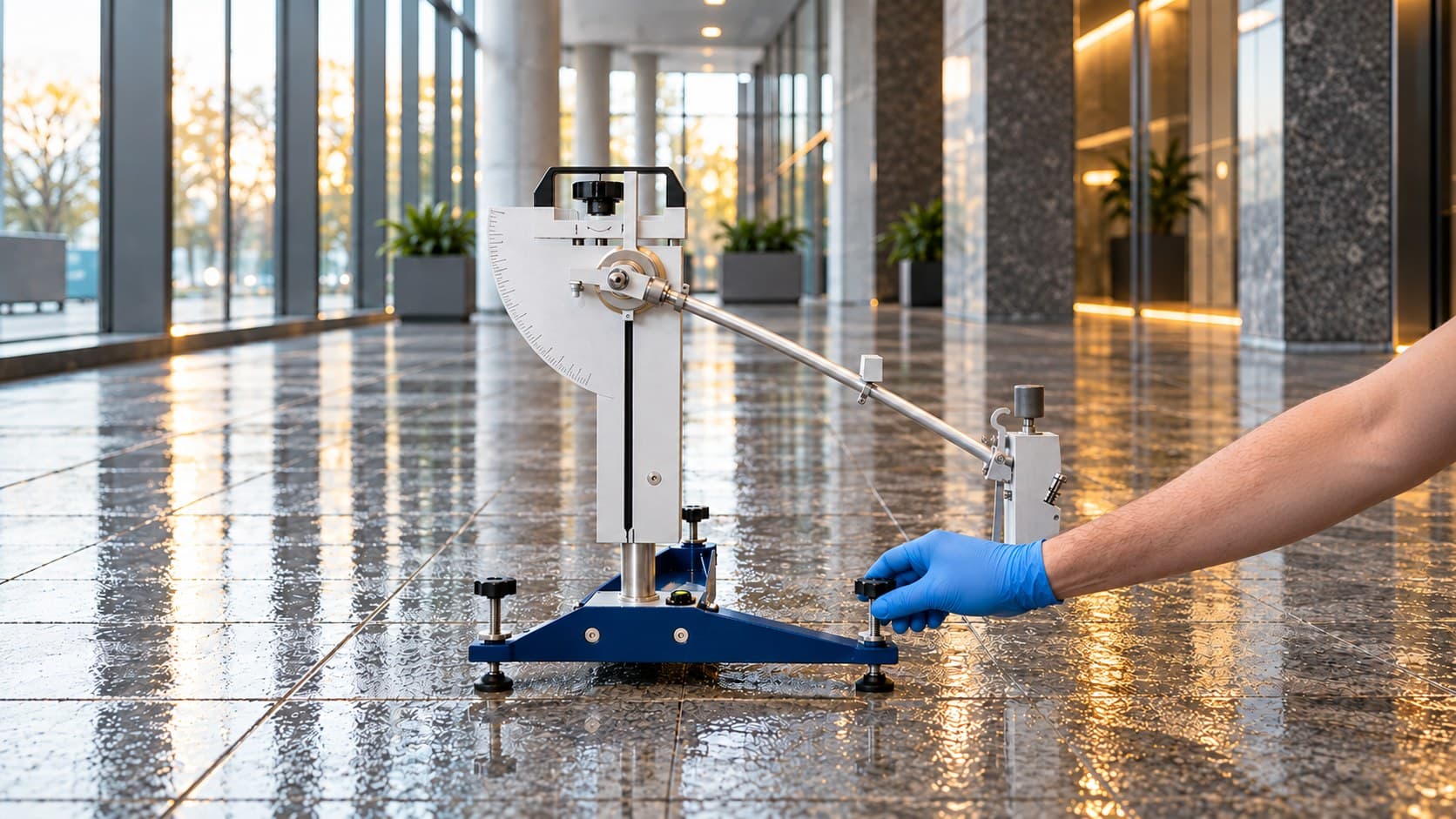
- Test floor slip resistance. The Building Research Institute (ITB) guidelines provide for testing in public buildings every 5 years and a threshold of at least 36 PTV. A pendulum test comes with a report of the results.
- Keep the documentation. A test report documents the floor's slip resistance and makes unfounded claims harder to bring.
- Act on a low result. Areas below the required value can be cleaned and given an anti-slip treatment, and the effect confirmed with another test.
- Mind day-to-day maintenance. The cleaning method, the kind of dirt and moisture all change how slippery a floor is.
More on regulations and requirements on the Knowledge: regulations and PTV page.
Note
The information above is general and is not legal advice. Facts and law are often far more complex, so when pursuing a claim, consult a lawyer.
Frequently asked questions
As a rule, the party that runs the shop and maintains the floor: the owner or the tenant of the premises. In retail chains this may be a franchisee rather than the brand on the sign, so check the details of the company running the store.